
Exosomes in Cancer Screening (Liquid Biopsy)
Today’s cancer screening tools often lack sensitivity and specificity. For example, routine mammograms
trigger callbacks in ~10% of women, yet only ~7% of those recalled actually have breast cancer
(implying over 90% false positives). Prostate-specific antigen (PSA) testing suffers similarly: only about
25% of men with elevated PSA who undergo biopsy are found to have cancer . Conventional imaging
and biopsy are expensive, invasive and often detect tumors only at relatively late stages . These
limitations have driven interest in non-invasive liquid biopsies that search for tumor biomarkers in
blood or other fluids.
Exosomes are ideal targets for such tests. They are abundant in blood, urine, saliva and other accessible
fluids , and tumor cells continuously shed exosomes carrying their molecular signature. In principle,
a simple blood draw could allow “omic” analysis (proteomic, genomic, lipidomic) of circulating
exosomes. Indeed, researchers have found that cancers of the lung, breast, prostate and many other
organs release exosomes with distinctive markers (mutant RNAs, oncoproteins, etc.) . In practice,
one envisions routine screening by profiling exosomal content: any cancer-specific change could be
detected early, perhaps before symptoms arise . Recent reviews emphasize that exosome
profiling has the potential to replace many invasive procedures, enabling earlier diagnosis and more
sensitive monitoring of cancer compared to standard methods
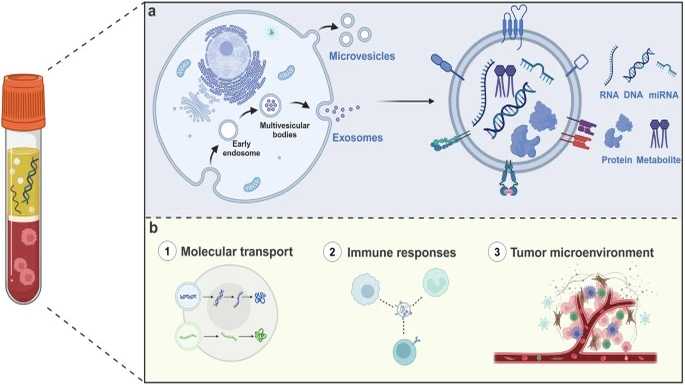
Liquid biopsy markers – exosome
https://www.nature.com/articles/s41392-024-02021-w
Therapeutic and Technological Applications
Exosomes are also being harnessed for therapy and biotechnology. Precision Drug Delivery (Trojan
Horse): Because exosomes are biocompatible and can evade immune clearance, they make excellent
drug carriers. Engineered exosomes can be loaded with small-molecule drugs, proteins or nucleic acids
and targeted to specific tissues. Notably, exosomes have been shown to cross the blood–brain barrier
under certain conditions , enabling delivery of therapeutics to the CNS. For example, Alvarez-
Erviti et al. loaded siRNA into neuron-targeted exosomes and successfully knocked down a brain gene in
mice . Exosome-based platforms are now being developed to shuttle chemotherapies, RNAi/CRISPR
agents, or immune modulators directly into hard-to-reach or protected sites.
Regenerative Medicine: Stem-cell therapies often work via secreted factors, and exosomes capture
many of these signals in a concentrated form. Scientists are exploring whether administering stem-cell-
derived exosomes can promote tissue repair (heart, cartilage, wounds, etc.) without transplanting live
cells (which carry a risk of tumor formation or immune reaction). Early studies suggest MSC exosomes
contain pro-healing miRNAs and growth factors. Thus, “cell-free” regenerative therapies using exosomes
aim to harness the healing signals of stem cells while avoiding cell-graft complications.
Overall, biotech and pharma companies are keenly investing in exosome engineering. Exosomes can be
decorated with targeting ligands (antibodies, peptides) and loaded with specific payloads, effectively
acting as a natural stealth drug-delivery vehicle . These approaches are at the cutting edge of
translational research: exosome-based delivery systems are already being tested in animal models and
early human trials.
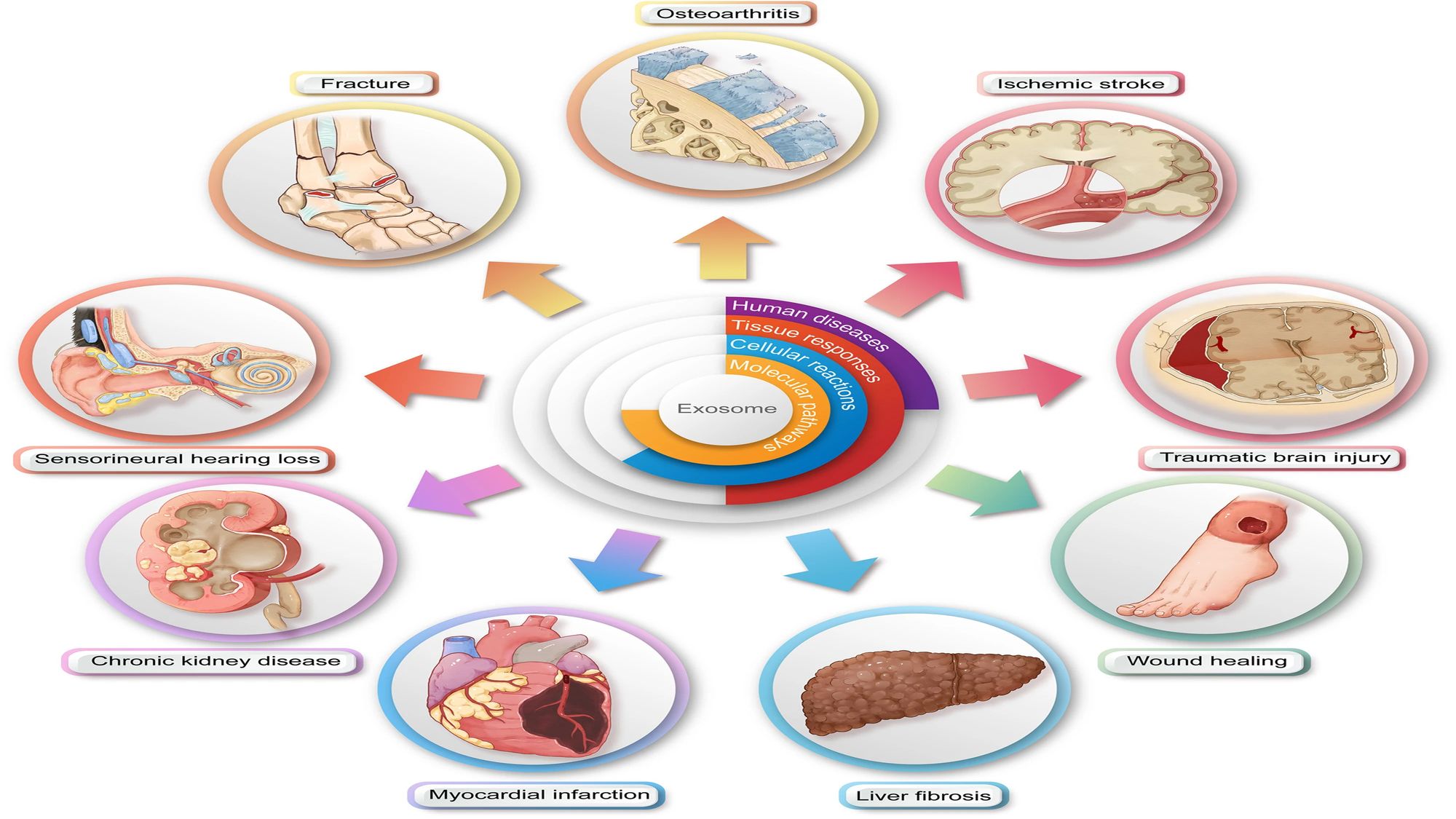
Illustration of the downstream surgical applications of exosome therapy
https://www.nature.com/articles/s41392-023-01704-0