
Historical Discovery of Exosomes
The first reports of exosomes came from studies of red blood cells (reticulocytes). In 1983 Harding,
Johnstone and colleagues observed transferrin receptor–containing vesicles being jettisoned from
maturing reticulocytes . At the time this was interpreted as disposal of old receptor proteins. In the
mid‐1990s, however, researchers showed a new role for these vesicles. Raposo et al. (1996)
demonstrated that B lymphocytes secrete exosomes bearing peptide–MHC class II complexes, and that
these exosomes can directly activate antigen-specific T cells . This finding indicated that exosomes
participate in immune signaling rather than waste removal. A major breakthrough came in 2007 when
Valadi et al. discovered that exosomes carry mRNAs and microRNAs which can be delivered to and
function in recipient cells . These and subsequent studies firmly established exosomes as a
fundamental intercellular communication system.
Biogenesis and Molecular Cargo
Exosomes are nano-sized (∼30–150 nm) lipid vesicles secreted by virtually all cell types into body fluids
. Each exosome is enclosed in a cell‐derived lipid bilayer that shields its contents from degradation
. Originally discovered in 1983 in maturing red blood cells , these vesicles were first thought to
be mere “garbage bags” for unwanted proteins. Later studies showed they selectively package proteins,
lipids and nucleic acids (mRNAs, miRNAs, even DNA) from the parent cell . Thus exosomes are now
understood as dedicated biological mail carriers: when released, they travel in blood, urine or saliva and
deliver their molecular payload to target cells
Exosomes form as intraluminal vesicles inside endosomal multivesicular bodies (MVBs). When an MVB
fuses with the plasma membrane, its internal vesicles are released as exosomes . These vesicles
range roughly 30–150 nm in diameter . Their membrane is a lipid bilayer (like the cell’s own
membrane) that protects the enclosed cargo from proteases and enzymes . Importantly, exosome
cargo is selective and complex. Proteomic and genomic surveys (e.g. the ExoCarta database) have
identified thousands of different proteins, lipids and RNAs in exosomes . In general, common
exosomal proteins include membrane tetraspanins (CD63, CD9, CD81), ESCRT- and trafficking proteins,
heat-shock proteins and antigen-presenting molecules . The lumen of exosomes contains cytosolic
proteins plus nucleic acids: they routinely carry messenger RNAs and microRNAs (which can reprogram
recipient cells) and even fragmented DNA . In sum, exosomes package a “fingerprint” of their cell of
origin in a protected form that can be delivered intact to other cells
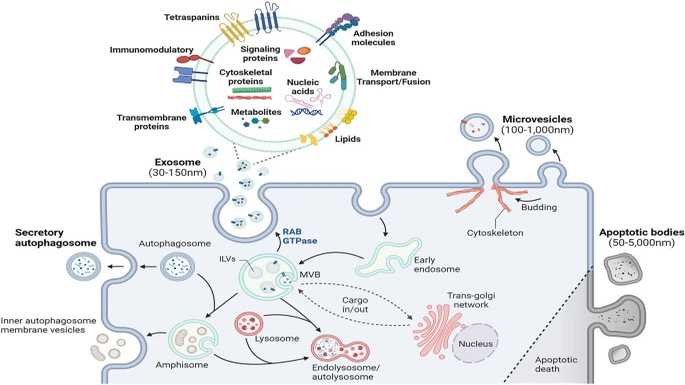
Mechanisms of extracellular vesicle (EV) biogenesis and EV components.
https://media.springernature.com/lw685/springer-static/image/art%3A10.1038%2Fs12276-024-01209-y/MediaObjects/12276_2024_1209_Fig1_HTML.png?as=webp
Biological Roles of Exosomes
Exosomes mediate diverse physiological communications. For example, immune cells use exosomes to
coordinate responses: exosomes released by antigen-presenting cells (such as dendritic cells or B cells)
display peptide–MHC complexes on their surface and can directly stimulate T lymphocytes . In tissue
maintenance and repair, stem cells and stromal cells secrete exosomes containing growth factors and
regulatory RNAs that promote wound healing and regeneration (for instance, mesenchymal stem cell
exosomes have been implicated in organ repair). On the other hand, exosomes play major roles in
disease pathways. Tumor cells release exosomes loaded with oncogenic proteins and RNAs that can
induce angiogenesis, suppress immune attack, and prepare distant tissues for metastasis . Likewise,
infected cells can shed pathogen-associated exosomes: these may alert the immune system by
broadcasting infection signals or conversely be hijacked to spread virulence factors and blunt host
defenses . In short, exosomes act as versatile intercellular couriers – their messages can coordinate
immunity and homeostasis, or, in pathological settings, promote disease.
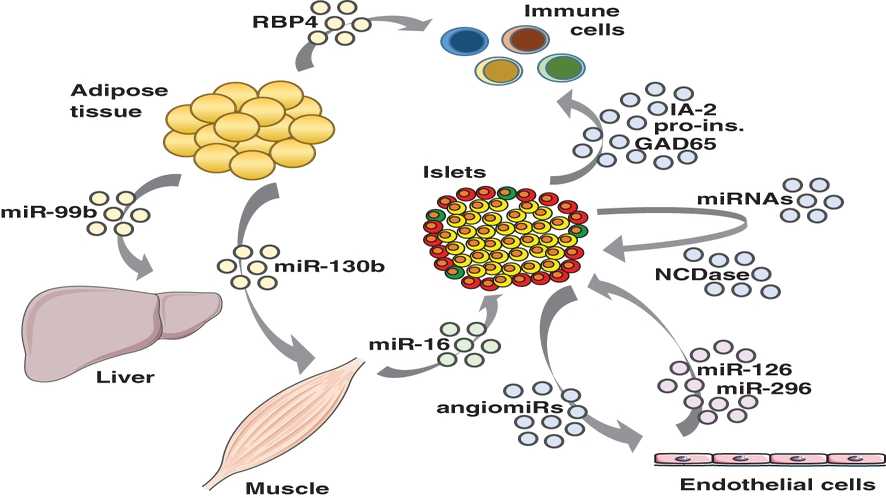
Exosomes as new players in metabolic organ cross-talk
https://exosome-rna.com/exosomes-as-new-players-in-metabolic-organ-cross-talk/